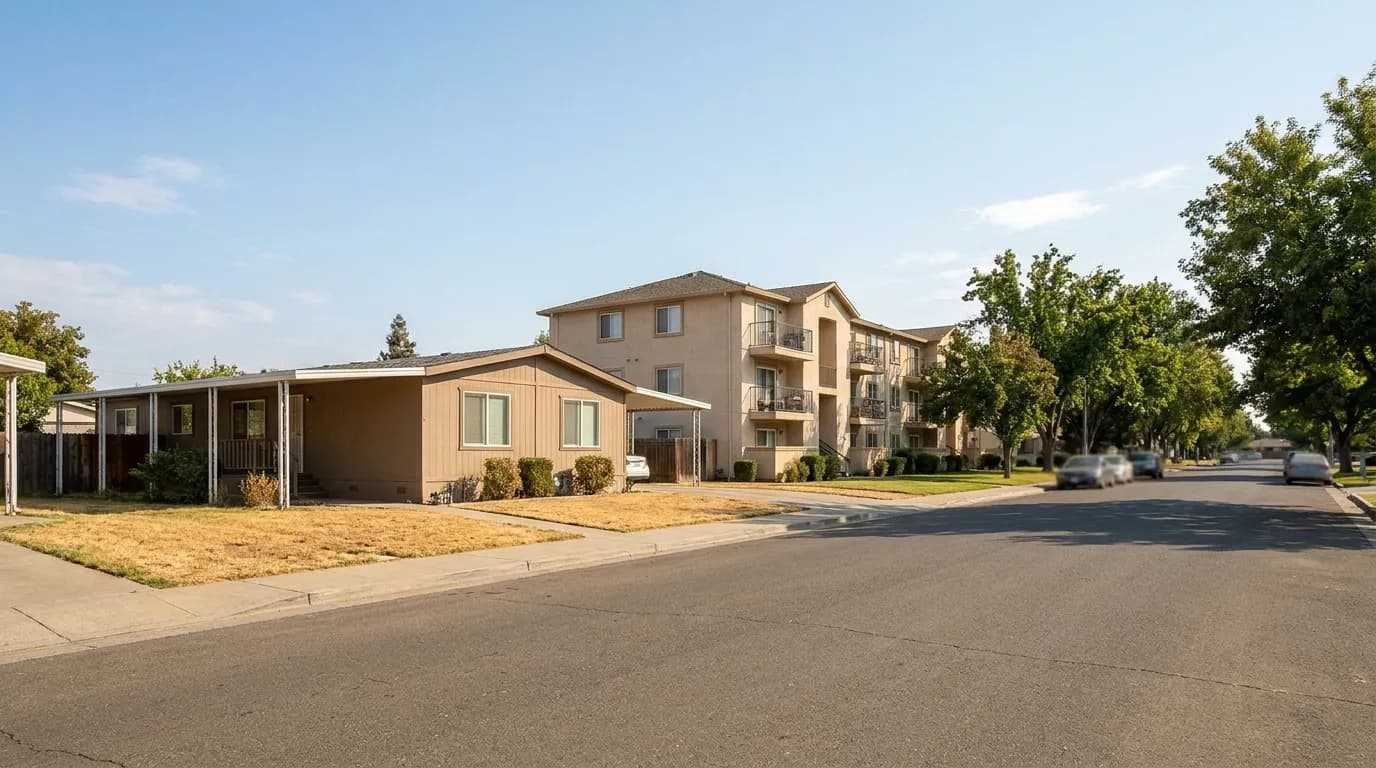
Two owners in the same Sacramento County community, in similar homes, can pay their housing taxes to two completely different agencies in two completely different ways. One gets a bill from the county tax collector. The other renews annually with the state.
Neither of them chose it. The system a home is in was almost always determined by when the home was first sold new, and the dividing line is July 1, 1980.
Understanding which side your home is on takes about ten minutes, and it matters at purchase, at sale, and every year in between.
The terminology the assessor actually uses
Sacramento County's assessor draws the line precisely, and it is worth borrowing their language because it removes most of the confusion:
- A mobile home is factory built housing first sold prior to July 1, 1980.
- A manufactured home is factory built housing first sold on or after July 1, 1980.
Before the Mobile Home Property Tax Law of 1980, these homes were treated much like vehicles in California and were taxed through license fees rather than property tax. That law changed the default going forward.
So the rule of thumb is simple. Manufactured homes, meaning those first sold on or after July 1, 1980, are on the local property tax roll and receive a county property tax bill. Homes first sold before that date may still be in the older state system, paying an annual in lieu license fee administered by the California Department of Housing and Community Development, unless they were converted at some point.
What each system looks like in practice
If your home is on the local property tax roll, you get a secured or unsecured property tax bill from the county tax collector, on the county's schedule, the same way other property owners do. The county assessor determines the value. If you believe you qualify for the homeowners' exemption or any other exemption, that is a conversation with the county assessor, not with HCD.
If your home is in the HCD system, you renew registration with HCD annually and pay the in lieu license fee. There is no county property tax bill for the home itself. Your title and registration records live with HCD rather than with the county recorder.
The first thing to do, if you do not know which one you are in, is pull last year's paperwork. A county tax bill naming the home means local property tax. An HCD registration renewal notice means the state system.
Converting from the license fee system to property tax
An owner of a pre July 1980 home paying the in lieu license fee may voluntarily move the home onto the local property tax roll. That is done by giving notice to the county assessor and recording the appropriate form with HCD.
Two things about that decision.
First, it is a one way door. Once a home has been changed to local property taxation, it cannot be moved back to the vehicle in lieu license fee system.
Second, whether it saves money depends entirely on the home's assessed value and on what the license fee currently runs. Do not assume either direction. Ask the county assessor to estimate the assessed value first, then compare.
There are also circumstances other than a voluntary election that can move a home onto the local roll. If you are not certain what applies to a specific home, HCD's Mobilehome Assistance Center at 1-800-952-8356 is the right place to ask.
The third path: affixing the home to a permanent foundation
There is a separate and more consequential change of status. If a manufactured home is installed on a permanent foundation, the owner submits form HCD 433A to the local building jurisdiction when applying for the foundation permit. Once that form is recorded with the county recorder, the home is subject to local property taxation in the same manner as a site built home.
This is the step that converts the home into real property, and it is the step that opens up conventional, FHA, VA and USDA financing for a buyer rather than the chattel loans that dominate community sales. It requires that you own the land, which means it is not available inside a rented space in a community.
Sacramento County spells out the assessment consequence clearly. Homes with a recorded 433A follow Proposition 13, with the factored base year value increasing by no more than 2 percent per year. Homes without a recorded 433A are handled differently on the downside: if market value falls below the Proposition 13 factored value, the lower market value applies temporarily under Proposition 8, and when market value recovers, the factored Proposition 13 value is restored.
That difference is not academic. It means an unaffixed home can see its assessed value fall in a soft market and then climb back faster than 2 percent a year as the market recovers.
Where this actually bites: the tax clearance certificate
Here is the point in the process where tax status stops being trivia and starts controlling your calendar.
When a used manufactured home on the local property tax roll changes ownership, HCD will not transfer the title until the county tax collector issues a tax clearance certificate. The authority is Revenue and Taxation Code section 5832.
The certificate confirms that no local property tax is due or likely to become due, or that any applicable taxes have been paid or will be paid in a way that does not require withholding the transfer. On a written demand for a conditional tax clearance certificate or a tax clearance certificate, the county tax collector is directed to forward it to the requesting escrow officer within five working days where no tax liability exists.
Two practical consequences:
- Which county issues it depends on where the home sits. A Citrus Heights, Carmichael or Rancho Cordova home runs through Sacramento County. A Roseville home runs through Placer County. If you are comparing communities across that line, you are comparing two different offices.
- Timing shifts with the calendar. Tax collectors commonly estimate the coming fiscal year's taxes when a certificate is issued after the start of the calendar year, and require that estimate to be paid before the certificate is released. A transfer in February and a transfer in September can feel quite different at the closing table.
If you are selling, request the certificate early. It is one of the most common reasons an otherwise clean community sale sits waiting. We go through the rest of that process in selling a manufactured home that sits in a California community.
A short checklist
- Find out whether the home was first sold before or on or after July 1, 1980.
- Pull last year's county tax bill or HCD renewal notice and confirm which system it is actually in today.
- If it is on owned land, check whether a 433A was ever recorded.
- Before closing, confirm who is ordering the tax clearance certificate and from which county.
- If the numbers do not make sense, call the county assessor for value questions and HCD for title and registration questions. They are different agencies with different jobs.
If you want help reading a specific home's tax and title picture before you commit, that is a normal part of a purchase here. See what is currently available, or talk through financing if the tax status is going to affect which loan you can use.
*This article is general information about California property tax and manufactured home registration and is not legal or tax advice. Statutes, fees and county procedures change. Confirm anything here with the county assessor, the county tax collector, HCD, or a qualified California tax professional before acting on it.*
Sources: Sacramento County Assessor, Modular, Mobile, and Manufactured Homes; California Revenue and Taxation Code section 5832; California HCD, Manufactured and Mobilehomes; California State Board of Equalization, Assessors' Handbook; California HCD Mobilehome Assistance Center
Want a second opinion on your specific situation?
Every community and every home is a little different. Joe can walk through yours with you, whether you are buying, selling, or just working out whether the numbers make sense.